Tuesday, 19 February 2013

Boca Negra : 'TWD : Baking with Julia'

If there was one word to describe this cake that we made for our fortnightly 'TWD: Baking with Julia' bake-together, it would be 'wicked'!! So wicked is this decadent, chocolate cake, that it has the power to evoke the seven cardial sins - gluttony, lust, greed, envy, sloth, pride and wrath!
 
In fact such is the intensity of chocolate in this cake, that it is called 'boca negra' or 'black mouth', because as Dorie Greenspan writes, that is what you'll be left with after a bite of this cake.

 
This cake has been conceptualised for the chocolate lover and it is ridiculously easy to make. It is all about melting copious amounts of chocolate with a bourbon sugar syrup, melting butter into it, whisking in some eggs and then, folding in the tiniest amount of flour. I made half the recipe and went with a smaller tin.

This cake is paired with a white chocolate bourbon cream in the book. While the cream sounded divine, it felt a bit over the top for this rich dessert. I went instead with a strawberry coulis to help cut through the richness of this cake.


The entire process went through smoothly. There is no leavening agent in this cake, so the cake does not rise. At the end of the baking process, you will have a dense, glossy, chocolate layer that has a thin, delicate, crispy top. When taken out of the oven, it will look very fragile but is in fact, quite resilient. I feared it would break when inverted out onto a plate, straight from the oven. Surprisingly, there wasn't an issue there.


This cake is best described, as a chocolate tart without a tart shell. Chocolate is all you will taste, so keep that in mind when deciding on the chocolate you use. I thought I would taste the bourbon but I couldn't taste any. The cake is dark, creamy, not too sweet and the kind that will leave you in a chocolate haze.


Not surprisingly, this is a rich cake and a small wedge goes a long way. This makes it ideal for a large group. This is a dessert cake that has no option but to be a crowd pleaser. Because as Mae West said, "To sin is human - but it feels divine"!

Friday, 15 February 2013

Whole Wheat Apple And Marmalade Cake

That I enjoy baking with the fruit of the season is something you've probably figured out by now. And I usually get my cue of what's in season, when the fruit gets seen everywhere from fruit stalls to roadside pavements to even, traffic signals.

From the tiny fruit in my mother's garden to mounds of the fruit on the pavements, oranges have been catching my eye for a while. Seeing it in such abundance had my inner Martha Stewart toying with the idea of making my very own batch of orange marmalade at home. I wasn't too fussy with the oranges I used. Simply went ahead with what was easily available in the market. The process is time consuming but nothing too complicated, especially if you have a candy thermometer, of which I am now a proud owner.


The marmalade turned out well for a first attempt. It had a beautiful colour, the peel remained suspended and did not sink to the bottom. It should have had a better consistency to cut through it and the purists would have pointed out that the bitter undertones should have been stronger. But, it worked well for me and everyone at home. And yes, indulge me with the cheesy, personalised label that I've used on the bottle! But, you've got to admit, it has its appeal! (Label Credit : Jam Labelizer)


But, I am not a jam/marmalade person. I enjoy it once in a while but it is not regular for my breakfast. So, while I pondered on how to get to the bottom of the bottle, I came across this cake in Nigel Slater's Ripe. He describes it as a 'good, reliable cake' that would be found in British village-fete cake stalls.
 
The flavour combinations sounded interesting and the cake used whole, wheat flour, a big tick mark in its favour. The cake comes together fairly easily. What I did differently was that I baked it in a loaf tin and omitted the raisins, simply, because I had none in the pantry at the time.


Reading through the recipe, you imagine a rustic looking cake and that is what you will get. This is not a cake for celebrations but perfect for your every-day, home baking. You can taste the orange and the cinnamon. The apples retain a slight bite although the skin did leach a bit and that is the pink that you see in the photographs. I did wonder if the whole wheat would yield a dry crumb but nothing of the sort. This cake was beautifully moist and it is recommended that you wait till it cools down completely, to let the flavours come through. And, it tastes even better the next day!!


This cake is a step towards the kind of baking I want to move towards. Baking with a healthier grain, with fruit and other healthier alternatives to traditional ingredients. But more than anything, this cake is what home baking is all about for me - rustic, no frills and full of flavour!!
 

Tuesday, 5 February 2013

Focaccia : 'TWD : Baking with Julia'

Every once in a while, you embark on a recipe where the final result fails so spectacularly, that you have to blog about it. You follow the recipe to the last word, everything happens as the recipe says it should, you check the correct temperature  of the oven and then you pop it in, confident of the final product. And then.... you pull it out of the oven and your heart sinks, it looks nothing like it should .. it's a complete fail!!


That's what happened with me, when I had to make focaccia for this Tuesday's bake together for "TWD: Baking with Julia" group. I popped the dough into the oven expecting a soft, well risen and fluffy bread. Instead I got a hard, thin bread that had hardly risen in the oven.

 
And what I don't understand is, where did I go wrong?? Till I popped it into the oven, the dough behaved as it should. It was soft, elastic and full of bubbles. The dough even squeaked as the recipe said it would. I even rested it in the refrigerator for 36 hours as the recipe recommended. As for spraying the oven with water, I did that too!! And yet... it flopped!! Any suggestions on where I went wrong??

 
What is even weirder, is that even though the bread did not rise in the oven to turn out fluffy and soft, with its liberal topping of thyme and salt, it was still delicious!! My end result was a crispy exterior and a thin chewy interior. The verdict at home was that it would go well with soup, something like bread soup sticks. But, I still can't figure out where I went wrong!??!

Sunday, 3 February 2013

Winter Salad of Pears, Blue Cheese and Walnuts

When you first start writing a blog, you are flooded with messages of encouragement and support from friends and family. Everything you bake or photograph is always greeted with superlatives and the kindest words. Then, a few months down the line, some of them started questioning discreetly, "So, do you eat ALL of that you make, at home or is there someone you share it with??". And by now, a few have come right out and proclaimed with a certain incredulity, "I do hope you are NOT eating all that you make!!" If you knew of my challenges with my metabolism, you would agree these are all valid concerns.
 
 
So, for all my concerned friends out there, you will be happy to know that I have made willing or unwilling guinea pigs out of all my friends and family. My unsuspecting neighbours have been particularly targeted!! I restrict myself to a small portion of whatever it is that I have made or baked. I have realised I bake not because I am a foodie, (in fact, I hardly qualify as one) but because it makes me happy watching people enjoy my food. It's as simple as that!!

But, to put your mind at rest, I bring you a salad today!! While salads are usually linked with summer, do remember the excesses of December haven't completely been erased. I found this salad in Nigel Slater's Ripe, fast becoming the book I turn to when I want to know what to do with the fruit of the season.
 
 
The salad works with the classic combination of pears and blue cheese and is further, embellished with toasted walnuts and pomegranate seeds. The salad dressing is a simple combination of vinegar-oil-cream. For the salad leaves, I only had iceberg lettuce to work with. Ideally, I would have preferred to use a combination of salad leaves, with some darker leaves to add to the visual look of this salad.
 
Reading about the salad, you imagine that the flavours of the blue cheese would dominate. But, here is where the delicate pear surprises, as it stands up effortlessly to the cheese. The toasted walnuts with their nuttiness are a welcome addition on the textural front. The pomegranate seeds add a certain jewelled visual to the salad with the dressing being the glue that brings it all together.
 

This salad looks deceptively light and delicate but in fact, has some robust flavours that make it ideal for the season. The salad is so flavoursome that it should be the highlight of your meal. Pair it with something simple like I did, with some chicken sandwiches.
 

Sunday, 27 January 2013

Cranachan

Every year, on January 25th, Scots around the world remember their most celebrated cultural icon, the poet, Robert Burns. Burns' poetry ranges from the romantic to the satirical, from the patriotic to the liberal and from the idealistic to the egalitarian. Widely regarded as the national poet of Scotland, his life and works are commemorated on his birth anniversary with a night of revelry, known as 'Burns Night'.
 
Burns Night is an institution of Scottish life. From traditionally formal to boisterously informal, it is a night that includes Scottish music, a traditional Scottish meal, recitation of Burns' work, all which is washed down with copious amounts of Scotch whisky.

 
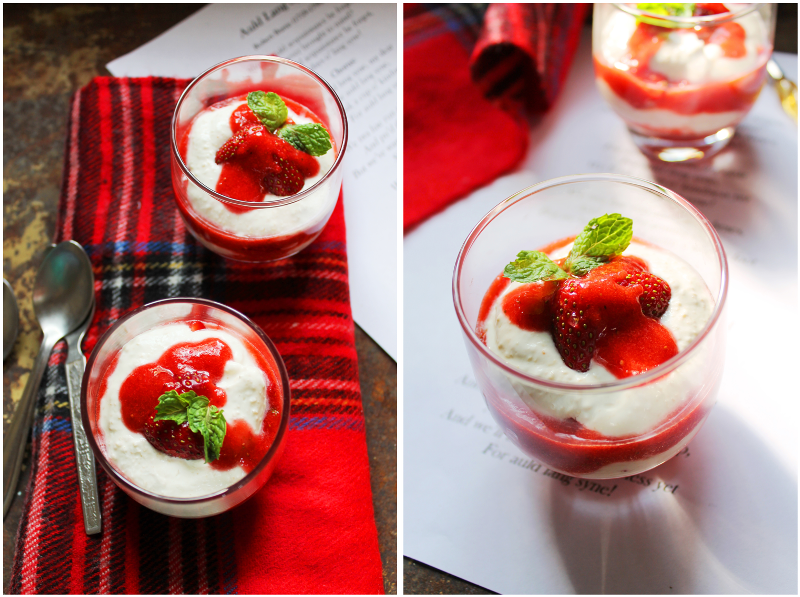
I reckoned there was no better time than Burns Night, to try my hand at a traditional Scottish dessert, the cranachan. In it's most simplest version, it is cream flavoured with oatmeal, honey and whiskey and then, much like a trifle, layered with fresh fruit. Since, I have already anointed January as the month of strawberries in India, it would be my fruit of choice.
 

It doesn't get much easier or faster to whip up a dessert than a cranachan. It took me all of fifteen minutes to prepare it. The only cooking you do is to toast the oatmeal. And for the fruit layer, I pureed half of the strawberries and kept the rest as quartered pieces.
 

The dessert is simplicity at its best. Oatmeal gives the cream a certain amount of body to retain shape when it is layered. Flavoured with a touch of honey, the whisky imparts a certain warmth to the cream. And of course, you cannot go wrong with the pairing of strawberries and cream.
 
While this may look like a trifle, this is more like a posh version of strawberries and cream, without the messiness of an 'Eton Mess'. This is a dessert that delivers on simplicity, elegance, practicality, time and most importantly, taste.

 
I leave with you with a few words from one of Burns' most well-known poems, written in 1788, 'Auld Lang Syne'. Popular throughout the world and is sung usually at the stroke of midnight, to bring in the New Year. Burns claimed that he collected the song by writing it down from an old man's singing. The title can be loosely translated as "For (the sake of) old times".


Extremely nostalgic, it remembers the times gone by, with a call to remember long-standing friendships. A sentiment that will always find resonance, despite the strains of time and change!!
 
 
Should auld acquaintance be forgot,
And never brought to mind?
Should auld acquaintance be forgot,
And days o’ lang syne!
 
For auld lang syne, my dear
For auld lang syne,
We’ll tak a cup o’ kindness yet
For auld lang syne!
 

Tuesday, 22 January 2013

French Apple Tart : 'TWD : Baking With Julia'

Nearly a month after I last baked with the 'TWD : Baking with Julia', I rejoin them this Tuesday with the French cousin of the Apple Pie, a French Apple Tart . Turns out the difference in title of the two desserts is more than just semantics. There is a technical difference between a pie and a tart. A pie with its crisp, flaky crust is much deeper than a tart and served straight from the pie dish. The tart is made in a pan with a removable bottom, only has a bottom crust and the goal a firm, crumbly crust. Honestly, for a non-purist like me, its more like "you say potato, I say potahto"!!


So, now that you've got your baking lesson of the day, we get back to the recipe on hand. The crust is made with the dough that we had used earlier to make this peach leaf pie. The filling is a cinnamon-apple compote that is then topped off with a beautiful, classic arrangement of dark-edged, paper thin apple slices that the French refer to as a 'rosette'.

 
Having worked with the dough before, the crust came together beautifully. The oven-roasted compote, too, is fuss-free and easy to prepare. The rosette, well, was a different story. The photographs say it all. "Quelle horreur, ma cherie!!", I can well imagine the reaction of a horrified patissier at my disastrous, clumsy attempt at recreating his beloved rosette. Instead, I take refuge in the words of Julia Child when it comes to imperfect food presentation. In her own words, "Never apologise, never explain". Amen!!


Apart from the look of the rosette, it all turned out beautifully. You had the buttery, firm crust that yielded to a creamy apple compote with lemon and cinnamon undertones. The thinly sliced, dark-edged apple slices on the top are a welcome textural change to the oven-roasted compote that lies beneath it. I am particularly partial to the combination of cinnamon and apples and went with an additional sprinkling of cinnamon powder on the rosette of apples.


But, here's the thing, there is nothing wrong with this apple tart. Each individual component turned out as it should. But, I think when it comes to the filling, I still prefer the all-apple slices filling of an apple pie as compared to this combination of apple compote with slices just on top. I seem to enjoy the bite of the apple slices much more than the texture of apple compote in my tart. Again, that's just my personal preference!! I'll leave it for you to decide on how you like your apple tart!!

A year ago: Venetian Carrot Cake

Sunday, 20 January 2013

Pavlova

January is my year's sweet spot. You are filled with optimism for the year ahead, with hope that your plans will work out and more importantly, you haven't yet started despairing as to how the days and weeks just seem to fly by. Unless you live in northern India, the weather is just about right at this time of the year. In complete antithesis to snowed-out Europe, we have blue skies, pleasant days, gentle sunshine, flowers in the gardens and the best part, strawberries in the markets!!


I think I wait all year for January, just for the strawberries that this month brings. I spend the excruciatingly hot Indian summer in envy, as blog after blog in the Western hemisphere goes crazy about their love affair with the summer berries. I make a mental note of all that I want to make with these beautiful red berries and then bide my time patiently till they make their grand entry into our markets.


Ever since I've heard about the Pavlova, I've been wanting to make it. I've never eaten it nor ever made it before. All I know is that the Australians are crazy about this meringue dessert that has a crisp shell with a soft, light, marshmallowy inside. It is served with a layer of cream and fresh fruit. With the weather being just right to work with meringue and cream, I reckoned it would also be a perfect choice to showcase the strawberries of the season.

For the recipe of this Aussie favourite, I turned to another Aussie favourite, Donna Hay. You already know what a Masterchef Australia junkie I am and this is where I first saw Donna Hay unveil a pavlova and it's been on my 'to-make' list forever!!


Preparation for the pavlova hardly takes much time. Just be precise with your measurements, whisk your egg whites to their desired stiff-peak form and don't let even a tiny speck of moisture come anywhere near the mixture and you are good to go. The baking time is on the longer side and then there is the subsequent cooling time. But, trust me, your patience will be well rewarded!

The pavlova was a dessert created in honour of the Russian ballerina, Anna Pavlova, during her tour of Australia and New Zealand in the 1920s. Make this dessert and you will understand where this dessert gets its inspiration from. Much like a ballerina, at first glance, this dessert looks feminine, graceful, simple, dainty and pretty. And just as the grace of her movements and the lightness of her step are in sharp contrast to a ballerina's tremendous muscular strength, the light, delicate marshmallow filling of this pavlova also contrasts with its crisp, surprisingly resilient outer shell. The inside filling is so light that it just seems to vanish, leaving you with the fresh fruit and a slightly chewy bits of the shell. It is not cloyingly sweet nor too heavy on the palate.


Strawberries and cream are a 'never-fail' combination and with this pavlova, it creates an elegant, complete dessert. This dessert is so beautifully light and fresh and that makes it ideal as a dessert for a meal that has been on the richer side.
Make the pavlova and you will understand why the Australians are crazy about it.This is such a fun, light and elegant dessert and declared an outright winner by all at home. I just wonder why it took me so long to discover it!!

A year ago: Strawberry Galettes
Related Posts Plugin for WordPress, Blogger...