Showing posts with label yoghurt. Show all posts

Tuesday, 12 September 2017

Dahi Vada

Despite having visited Delhi over the years, the visits have always been fleeting. Never enough time to explore the facets of a city that they say, has risen and fallen and then risen  again (seven or is it eight times), each time with the fortunes of a different empire and its rulers. And yet, over the past year, three books have taken me to the heart of Old Delhi, bringing it alive at three different points in time.

It all started with Pamela Timms' 'Korma, Kheer & Kismet'. Fed up by the set rules of an expat's life in Delhi, she embarks on a journey to experience the street food of Delhi with it's seasons as her backdrop. She braves Delhi's unbearable Summer for a plate of Ashok and Ashok's mutton korma that finishes within an hour of opening and endures the lashing Monsoon rains and scare of the infamous 'Delhi belly' to try the Mughlai food in the streets around Jama Masjid. The sight of a mound of shakarkhandi (sweet potatoes) atop a khomcha wallah signals the cooler days of early autumn and chilly Winter mornings are spent in the search for the ephemeral 'Daulat ki Chaat'. And in between she visits a whole plethora of small shops and eateries that dot the landscape of Old Delhi feeding the multitudes of residents, immigrant workers, shoppers and curious travellers alike. In her quests, she goes anywhere and everywhere. From Pt. Ved Prakash Lemon Wale's nimboo soda to Old and Famous's jalebis to Gopal Krishna Gupta's aloo tikki to Bade Mian's kheer to a whole host of other places that all sell that one unique dish that they have perfected over the generations, never to be replicated by another.

In her aimless rambles around the streets and bylanes of Old Delhi, she surrenders to the chaos and embraces the mayhem that is Old Delhi and in return, it's people open their homes, kitchens, hearts, lives, dreams and just about everything else except of course, that closely guarded family recipe. With her words, she brings alive the Purani Dilli of today with all its quirks and idiosyncrasies, as the city continues to reveal itself to her through its street food and the people and families behind it.


The second book was Ahmed Ali's 'Twilight in Delhi' that I got to know of while reading another book on Delhi, a couple of years ago, 'City of Djinns' by William Dalrymple. Set in the early 1900s, the author sets out to describe in painstaking detail the days and lives of the people of Delhi at the time. Of women cloistered within the four walls of the zenana oblivious to the humdrum of life navigated by the men outside. Of days punctuated by the calls to prayer, cries of street vendors, whines of beggars, sounds of craftsmen at work, blessings of the fakirs and poetry on the lips of everyone when mere words would not suffice to convey the emotion of the moment. Of nights that belonged to courtesans whose beauty and allure hid a lifetime of heartbreak and denial. Of marriages arranged, festivals celebrated, epidemics battled and deaths mourned. 

But, this is all in the shadow of time when the Mughal Empire was defeated, its rulers exiled and its people looked on as a new colonial ruler sought to stamp its authority at the cost of the local culture. The flashes of despair and melancholy that you glimpse early on in the book grow to a vice like embrace by the time you reach the last pages. Partition's unfortunate legacy would mean that the author had to leave for Pakistan and the Oxford University Press would reduce the book to being described as 'a novel that describes.. ..a way of life in the predominantly Muslim areas of Delhi'. What it is, is a book that documents a time in the life of this city lost forever as it was on the cusp of being re-imagined by its new rulers from the ashes of the previous empire. 

And finally, the book that captivated me completely was Madhur Jaffrey's 'Climbing the Mango Trees', her childhood memoirs. Born into a Kayastha family, a community that were traditionally the record keepers of the Mughals and who would make the transition under the new colonial rulers. On a historic timeline, this books picks up where Ahmed Ali's book ends. Growing up in a large joint family in a house overlooking the Yamuna, she takes you into the world of her childhood. A world where Mughal, British and Hindu influences would intermingle while the country inexorably marched towards Independence. While she discusses the social milieu of the time, this is a book about her childhood. 

She introduces you to her large joint family over expansive family meals with its doses of bonhomie and humour and underlying currents of gossip and speculations. You accompany her on her summer holidays in the hills and her trips to the Yamuna river bed for the choicest pick of watermelons. You watch as her elder brothers and sisters grow up and embrace their lives and loves. She takes you to her school and you meet her teachers, friends and that comes with school life. And there's so much more she will reveal about her childhood and with such honesty and intimacy and with a language so descriptive that these recollections don't feel like those of a stranger but those of a grandmother or grand aunt by whose side you sit as she reminisces. 

Most of us today know Madhur Jaffery as a cook book author and you'd imagine her book to be about food and in that assumption, you won't be doing this book justice. Food weaves itself through the pages of this book as inextricably as it always does with our memories. But this book is so much more. It is about her growing years in all its intimate and innocent detail which you will remember long after you've read the book.

All this talk of Delhi had me pulling out a recipe for Dahi Vadas or as the Dilliwallas call it, 'Dahi Bhalle'. I would describe them here but Madhur Jaffrey does such a delicious job of it that why bother. She describes them as "fried split-pea patties spread with creamy yogurt, salt, a hot chili mixture and, finally, tamarind chutney “as thick as melted chocolate." And then she goes on to write that "the dahi baras would melt in our mouths with the minimum of resistance, the hot spices would bring tears to our eyes, the yogurt would cool us down, and the tamarind would perk up our taste buds as nothing else could. This to us was heaven.”

After such a description, there is really nothing more for me to say except that I've shared my mother's recipe but goes without saying that every home in India would have their own trusted one. It is a simple enough recipe that goes down a treat during tea time. 

For a city that keeps rising from the ashes ever so often in the history of time, I leave you with these words of Anupreeta Das, "Delhi now belonged to everyone who lived in it. But no one belonged to Delhi."

Saturday, 10 September 2016

Lemon And Yoghurt Ciambella

The seasons are changing. It's been a good monsoon in my little corner of the world and I can now sense it's retreat. And this year, I have accepted every bit of the monsoon, without a word of complaint. I love the rains but there have always been spells before, when I said, enough, the rain need to take a breather. But, not this year. Not after that absolutely horrific and brutal Summer we had to endure. 

So, yes I have accepted every mood and every spell of the rains. From days, when the sheer excess of it swept away all that it came in contact with to the day when, it teased us with a little drizzle with the promise of more to come. I have enjoyed seeing the landscape turn from that dried-out, parched shade of brown to that playful, vibrant shade of light green that speaks of revival to that dark, saturated shade of verdant green that tells you that the monsoon has kept its promise. Little, white flowers whose scent were a Summer evening's only retribution have made way for rich, vibrant flowers, all in time for the upcoming festive season. So yes, its been a good season and the seasons are now changing. 


But, whatever be the season, there's always time for some cake. And this time, it's a lemon cake. For no other reason, that all my recent posts after the Summer have been chocolate based and that needed to change. 

This is a lemon and yoghurt cake, baked in a ring tin and then topped with a lemon, sugar drizzle. The recipe is by Donna Hay and it can't be simpler. You literally have to bunk all the ingredients in a bowl, stir and then put it to bake. 


And no, you cannot ignore that drizzle. I know my photographs don't do it photogenic justice, but trust me, you can't leave it out. That's what ups the lemon quotient and leaves that twang in your mouth, the kind you are left with after say, a lemon tart. But learn from me and let the sugar dissolve, just a wee bit so that the juices release and its a more spreadable consistency.

I've used demerara sugar as I now do with most of my baking and is the reason why my crumb is that shade of brown as opposed to a white crumb, if I had used regular sugar. Use whatever you have at home. I have used a bundt cake tin, but this cake can also be baked it a regular cake tin or even loaf tin.

Goes without saying, bake this cake only if you love lemons. Else, you are better off baking another cake.


I have called this cake a 'ciambella', that's Italian for a bundt cake. I could have called it a bundt cake but for some reason, I found the word ciambella (pronounced cham-bel-la) so evocative. You can just imagine the whole scene. One of the little villages along the Amalfi coast with its pastel coloured houses and the boats bobbing in the sea. The air is perfumed with the scent of lemons and while the catch of the day is being unloaded, you sit with your journal with a cup of coffee and a slice of this lemon ciambella. What a lovely way to start the day. Ohh..indulge a girl and her arm chair travels! 

Have a beautiful weekend, wherever you are, all you lovely people!


Sunday, 5 July 2015

Plum Coffee Cake

I never really know what my next post is going to be. It is usually guided by the season of the moment but apart from that, I get my ideas from just about anywhere. Like last fortnight, when one of the total five readers that this blog has, asked me for a plum and frangipane cake, I was more than ready to oblige. And then Ma pointed out that it's been a while since I had baked a cake. Considering she is also among those five readers, I couldn't put it off any longer!
 
So, on 'popular demand', I made a plum coffee cake. And no, a coffee cake has no coffee in it, it is just meant to be had with a cup of coffee!!  

 
Cakes like this one are my favourite cakes to bake and you will see versions and adaptations of it in the recipe index. It is seasonal and so simple that all it requires is a hand whisk and two bowls, one each for the dry and wet ingredients. Once you have all the ingredients in front of you, it doesn't take more than ten minutes before you can pop it in the oven.


This is a simple cake that is given character with ground almonds and orange juice. It has no butter but uses a yoghurt-oil mixture that yields a super moist cake. The best part of the cake is its topping. The plums are sprinkled with sugar before baking. This ensures that the fruit cooks during baking and goes all soft and roasted and it releases all its beautiful juices that makes it just the perfect accompaniment for that cake beneath it.
 
While the fruit cooks, the sugar sprinkled on top caramelises to make this dark, slightly crunchy crust that contrasts beautifully with the vibrant, moist cake inside. You don't need to serve this cake with anything, just maybe a cup of coffee.


This is such a flavourful cake that has this beautiful, rustic charm about it that I can see you enjoying it as much as we did.
 
And if you have any ideas for future blog posts, I am always listening! Have a great week ahead!!

Wednesday, 1 July 2015

Saffron And Anise Poached Apricots With Cardamom Scented Yoghurt

As I mulled over on how to finish off the last few fresh apricots in the bowl, I headed over to social media for a spot of inspiration. And the timeline was filled with stories on Ramazan and a lot of them had to do with food. They were bloggers sharing ideas for 'iftar' dinners at home and articles by food lovers on the cities' most revered and popular eating joints, each an institution in their own right. Photo features on the tiny lanes of the traditional Muslim neighbourhoods, all lit up and buzzing with food stalls, crammed against each other, that come up every evening of Ramazan to  cater to the faithful, after a long day of fasting.
 
This is rich, decadent food in all its glory, that pulls no punches. And amidst all that food, mostly meat dishes, there is of course, always a mention of something sweet. Most of it were familiar sweets like phirni, malpuas, jalebis, sheer khurma, falooda but there were a few unfamiliar ones, like sandaal and 'khubani ka meetha'.


'Khubani ka meetha' caught my eye because 'khubani' is the Persian word for apricots. Popular in Hyderabad, it is a dessert made with dried apricots that are cooked with a sugar syrup to make a sort of a compote that is served with cream. However, the photographs are not too kind to it. The compote looks like some sort of brown sludge which I'll admit does not look very appetising.
 
But, I liked the idea of cooking apricots in a sugar syrup. Only instead of the dried ones, I used the fresh apricots that I had. And instead of cooking them into a compote, I decided to maintain their integrity by gently poaching them with some saffron and star anise.
 

Star anise because I like the way the spice flavours fruits and saffron because it imbues everything with that beautiful colour. I paired the apricots with some lightly sweetened and cardamom scented yoghurt. But, feel free to use whipped cream or even, some vanilla ice-cream if that is more to your liking.
 
Poaching fruit is a beautiful way to use up the fruit for a simple dessert. The cardamom in the yoghurt is very subtle because the star of the show are the apricots. That reduced saffron syrup just ties it all together beautifully with the help of those chopped pistachios on top.
 

It is fruity, lightly scented and delicately flavoured and does the job beautifully for a dessert on a week night. Try it before the apricots simply vanish from the market!
 

Tuesday, 28 April 2015

Mango And Banana Frozen Yoghurt

Oh dear dear, Summer's here! Normally I would have begun on my rant but that's so predictable that it's pointless. So, instead let's talk about things that I think will interest you.

Last week, Monica Bhide, food writer, storyteller and in the words of her book, 'culinary explorer, cultivator and teacher', asked on Facebook if anybody would like to read her soon to-be-released book, 'A Life of Spice'. Of course, I put up my hand and she very graciously sent me the Kindle link to her book. I started it on Saturday afternoon and read it pretty much uninterrupted till I finished it by Sunday afternoon.

The book is a collection of essays that Monica has written over the years. To say that it is about food or about Monica's love for food would be missing the point completely. Her stories are about how the memories we have and the memories we look to create are invariably and inextricably linked with food.


Of the family who will always remember their last meal as they leave their home forever, never to return. Of the adult who will always become a child when she returns to her parent's home, craving the dishes of her childhood. Of the experienced cook who will always remember all the disasters as a novice. Of the mother who feels her child is growing up too fast and holds on to those precious moments when they bond together over the kitchen counter. Of the immigrant who has adopted a new country but will never shake off the food and customs of the homeland. These and many more of Monica's stories bear testament to the fact as time passes and life moves on and change is inevitable, we are left with memories and more often than not, they have a connection with food. 

And while these stories are a peek into Monica's life, they are so evocative that they compel you to explore your own 'Memory's Kitchen'. Read the book and you will understand where I get the term from!

Monica confesses to a torrid romance with food and she proves it when she deftly brings it to life in her writing. "...coriander whimpers, cumin smolders, mustard sizzles, and cinnamon roars.." is just some of the magic she creates with her words!


And talking about food, I made some mango and banana frozen yoghurt. The weather is certainly calling for it. It takes just three ingredients and it's so fuss-free, I don't think you can even calling it cooking.

You can't fault the dessert but I would make two suggestions to make it better. We are right in the bang of mango season and I wonder if the banana was really necessary. Personally, I would stick solely with the mango.

And secondly, you know I don't like my desserts cloyingly sweet and yet I found this dessert lacking something. I won't recommend that you add sugar but rather you drizzle, a generous amount at that, of honey over the yoghurt. It instantly transforms it from the ordinary to the elegant. Perfect for lazy summer weekends!


Before I sign off, I'd like to draw your attention to a petition by Dastkar to protect the intellectual property rights of India's traditional handloom weavers from the powerful powerloom lobby. Please do take time to read this petition and sign up your support to protect India's rich textile legacy.

Over the weekend, a powerful earthquake hit Nepal and we've seen the devastating images all through the weekend. For those looking to donate/help/volunteer, this link might be of help. A prayer for the victims as they stand vulnerable and defenceless in the face of Nature's might!

Wednesday, 25 March 2015

Dahi Baingan - Aubergine Cooked in Yoghurt / Lemon Rice / Fried Spiced Bhindi (Okra)

Last weekend, Jamie Oliver threw his voice behind 'Meat Free Week', a campaign that is being launched in the UK, after its launch in Australia in 2013. Meat Free Week is an online campaign to not only make people think about the amount of meat they consume and the importance of a balanced diet. But, it also compels us to think about the origin of all the meat, including processed meat, we consume and its impact on the welfare of the animals and this planet. To cater to the enormous demand for meat around the world, a large part of the meat we consume is factory farmed and factory farming is the number one cause for animal cruelty in the world today.
 
So, this is not a debate about vegetarianism but a platform to educate ourselves and make ourselves aware and make informed choices about the origins of the meat we eat. Just as we should be informed and aware of where our vegetables, our fruits, our grain and our dairy products come from. That's something to think about!!

Coming back to today's post, if there is one cuisine that celebrates its vegetables, it has to be Indian cuisine. For the sheer variety of vegetables available in the market to the diversity of ways of cooking them, it is very easy to go without meat in India. Moreover, with Summer here, I, anyhow have a personal preference for less meat.
 
 
In this weather, I, like many other Indians, can't help but lean on yoghurt as a way to cool the system to take on the rising temps. So, I made 'dahi baingan', a dish from eastern India that cooks aubergine in a simple, yoghurt curry. The curry is light and creamy while being light on spice with a tinge of sweetness. As you can see, in this weather, I also prefer less spice.
 
I paired it with lemon rice where the rice is flavoured with curry leaves, some whole spices, lentils and lemon, of course. It does have some whole red chillies but more to add to the flavour profile, not so much for spice. It works well with creamy curries from down South. So, I saw no reason why it could not be paired with the 'dahi baingan' and I was right.
 
 
This is all about flavour that is subtle and light on the palate, perfect for the weather in mind. I added some okra fries in the mix and that is purely as an indulgence and to tease the palate with some crunch and spice.
 
Fried vegetables as an accompaniment is a weakness of mine that I have inherited from my mother's side of the family. The food from Odisha is light on spices and the emphasis is on the letting the taste of the produce shine through. Their one indulgence, amongst many, is to fry different vegetables as an irresistible accompaniment to the meal. Potatoes, cauliflower, spinach, pumpkin flowers and any other vegetable that can be fried usually makes it to the table and they are so addictive that they compel you to throw all caution when it comes to portion size. As for these, okra fries, make them once and you will know what a good thing you are onto!!
 
 
Each of these three components can be had together or made on their own and paired with different components. Pair the lemon rice with a coconut based curry or the dahi baingan with some plain rice and dal or even meat. As for the okra fries, I'll suggest that you can even serve them as a bar snack!!
 
I'll sign off saying that there is a great need for all of us to educate ourselves on where our food is being sourced from so that we can make informed choices that are kinder on the world we live in.
 

Friday, 6 March 2015

Shrikhand - Sweet Saffron and Cardamom Yoghurt

The different flowers of my mother's garden, each have their own story to tell. At the height of summer, the mogra, jasmine, 'raat ki rani' and frangipane flowers are in full bloom. Their sweet scent infusing the Summer evenings, providing that much needed succour. You know the monsoon is receding when the flowers of the 'harsingar' trees carpet the ground every morning. And in good time, as they are extensively used during the festive season of Navratri that coincides around the same time. The roses make the first of their bi-annual appearance to signal the onset of Winter. The red hibiscus flowers through the year, used for her daily puja.
 
And then there's Holi!! This is when all the seasonal flowers she has planted at the onset of Winter are now in full bloom, all in their myriad of colours. Some like the calendula, the phlox and the hollyhock are exotic to the Indian soil. And then there are  the marigolds, the roses and the hibiscus, native to India. Dried and then ground into a fine dust, these flowers provide the perfect palette of natural colours to play Holi with!!
 
 
It points to a symbiotic relationship between our festivals and nature and how over time, we have lost touch with it. It is time we look more closely to rediscover this connect with nature. So, I hope you used natural, herbal colours, devoid of chemicals, when you played Holi today!! It is a small step to a more sustainable planet!
 
 
And what's Holi without something sweet. I kept it simple today and made some Shrikhand. For those not familiar with it, it is similar to the Middle eastern labneh.
 
Incredibly easy to make. Once you have let the yoghurt drain through the night, it takes barely a few minutes to put together. I will insist that you use full fat yoghurt. It helps immensely with the final result. I have flavoured these with classic Indian flavours, saffron and cardamom.
 
 
I have always bought Shrikhand shop bought. But all that changed with the one time I made Shrikhand at home. It was fresher, creamier, lighter and best of all, did not leave a cloyingly sweet aftertaste. I urge you to make it at home once. Pretty sure you will be converted like me!
 
 
Holi is all about colours and may your days be filled with the most beautiful that life has to offer! Happy Holi!!
 

Tuesday, 3 February 2015

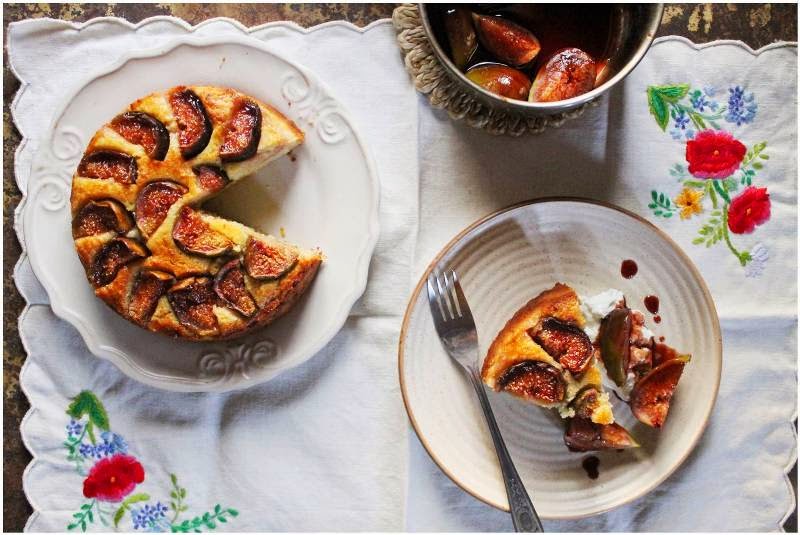
Fig And Almond Cake

It wouldn't be until I started working that I would sample a fresh fig for the first time. Am not sure why that was the case considering I have always loved them in their dried avatar and you always got them easily in Bombay. It would take my flatmate's parents to come visiting to get me to try one. Clearly ignoring the fact that we were no longer in college, her mother, much like mine, would stock up the pantry with the essentials and the freshest fruits and vegetables. They clearly had no faith in our housekeeping skills!!
 
Anyhow, on one of their visits, they brought home a box of fresh figs and that's how I got to eat my first fresh fig and have been hooked ever since. I have always loved how a dried fig tastes but cutting through the dark purple skin of a fresh fig and then encountering the luscious, soft, deep red flesh inside has a charm of its own. And since then, I wait every January when the fruit makes it to our markets!
 
 
I enjoy them just as they are, no adornments, no embellishments. But, over the years, they seem to be much more in abundance than before. So, I couldn't let them leave the market without giving this cake, on which I have had my eye on for the longest time, a shot!
 
The recipe is available on Ottolenghi's website, so, you know you are in safe hands! It is a cake made with almonds and Greek yoghurt and the top is adorned with fresh figs. The recipe states that while it was not needed, a red wine caramel syrup with fresh figs was recommended to go with the cake. Well, when the masters of cooking recommend it, who am I to say no!
 
 
The cake comes together very easily. I liked the fact that it has ground star anise, a welcome change from the usual cinnamon that I normally turn to. You won't only taste the star anise but you will smell it as the cakes bakes. Remember, there is no baking powder, so this is a dense cake in terms of consistency.
 
The recipe is right. You don't need the red wine caramel syrup but I will insist that you do not miss out on it. Toss some fresh figs in the syrup and then serve them with a slice of cake and some Greek yoghurt. The fresh figs along with the figs in the cake pay a fitting tribute to the fruit. The almond meal not only provides a different texture but ensures that a small slice goes a long way!
 
 
The red wine caramel syrup ties all the elements together and the Greek yoghurt ensures that it never gets too sweet for the palate. The hint of star anise that you encounter plays up the Middle Eastern heritage of the fruit.
 
 
If you love the fruit as much as I do, there is no way you should miss out on this cake. My mother, who personally does not like figs, enjoyed the cake with all its accoutrements. But, then again, I think she is unfairly biased towards this baker!!

Saturday, 27 September 2014

Pomegranate And Saffron Labneh

If you buy a pomegranate,
buy one whose ripeness
has caused it to be cleft open
with a seed-revealing smile.
 
Its laughter is a blessing,
for through its wide-open mouth
it shows its heart,
like a pearl in the jewel box of spirit.
 
A laughing pomegranate
brings the whole garden to life.
Whether you are stone or marble,
you will become a jewel
when you reach a human being of heart.
 
~ Excerpt from THE LAUGHTER OF POMEGRANATES by Rumi


As I told you last week, I was introduced to 13th century Persian poet and Sufi mystic, Rumi in Elif Shafak's 'Forty Rules of Love'. Am still in the early pages of the book but I am already getting entranced by his words that keep playing in my mind.
 
So, when I saw a whole mound of pomegranates at the fruit stall and then these words by Rumi, this post had to be next!
 
 
Tis the season of pomegranates right now and it is on my list of fruits that are best eaten alone. I enjoy its many contrasts. It is sweet and tangy at the same time just as it is juicy and crunchy at the same time. And then there's it's colour, that beautiful, luscious, sensual red that stains and changes all it comes in contact with, much like the 'human being of heart' that Rumi writes about.
 
It deserves a dessert that celebrates its unique personality. I found this beautiful dessert that paired the pomegranate with labneh on a fantastic blog by an ex-chef from Sydney, 'He Needs Food'. Drop by for a visit for gorgeous recipes and even more gorgeous photography.
 
 
Labneh is a yoghurt cheese, popular in the Middle East and is essentially yoghurt drained of its whey. Here, it is flavoured with saffron, cinnamon, cardamom and orange zest and then layered with pomegranate arils and juice. The original recipe has orange blossom water which I unfortunately could not find anywhere out here. A pity because that would have accentuated the Middle eastern character of this dessert.
 
And what a beautiful dessert this is. It will remind Indians of 'shrikhand' and that is what it essentially is. The labneh is light and refreshing on the palate without being cloyingly sweet. You then have the pomegranate that provides a textural and visual contrast that is most welcome. I do wish I had the orange blossom water. It would have mellowed the citrus tone of this dessert which was quite assertive because of the orange zest used.
 
 
This dessert is perfect to cleanse and cool the palate after a meal that has been heavy on spices. It is perfect for the all-vegetarian diktat that is now in place at home because of Navratri. And most importantly, it is perfect for the weather we are experiencing right now where the monsoons have retreated but winter is still some time away!

Friday, 18 July 2014

Indian Style Lamb Burgers With Herbed Yoghurt

Increasingly I have come to believe that for most people, food is about the familiar. Once in a while, we lean on our adventurous side and try out a new cuisine and flavours or get dazzled by the showmanship of molecular gastronomy. But, we come back to flavours that we are familiar with. It is comforting and unpretentious when one is faced with flavours one is familiar with.
 
Like the flavours in these lamb burgers!
 
 
I came across these burgers in Anjum Anand's 'Indian Food Made Easy'. She takes a regular lamb burger and spices it up with Indian flavours. So, you have ginger, garlic, coriander, green chillies, cumin powder and garam masala. And instead of a mayonnaise that would seem off key with the Indian flavours, we have a herbed yoghurt.


And the final flavour profile won't just appeal to the Indian palate but to anyone who enjoys the effortless ease with which spices can make food sing. This is not about spices that are overpowering and drench your senses with heat. This is about spices that subtly enhance the complexity of flavours while keeping it simple at the same time.
 
 
Yoghurt is a soothing complement to Indian spices. And the herbed yoghurt is perfect with these lamb burgers. The mint is a refreshing addition that helps cool the palate and counter any lingering heat from the chillies.


This is a beautiful rendition of a burger with Indian spices that comes highly recommended. Hope you have a lovely weekend!

Thursday, 5 June 2014

Summer Coolers - Bael ka Sharbat / Chaas / Vietnamese Iced Coffee

I am melting. I am wilting. I have simply stopped functioning. Yes, every summer I sound the same. No matter how much I try, the heat always seems to triumph. Every year, the summer seems worse than the last year and this year was no different. It's been brutal and unforgiving as ever!
 
The traditional Indian almanac has a period of nine days called 'nautapa' which are said to be the hottest nine days of the year. This period, I am told, ended on Monday and if you ask me, the heat only seems to have intensified since then. While everything around me seems overpowered by this searing white light of the Sun, my own mind and body have been overpowered by this lethargy where even the simplest task seems Herculean!! I know I sound melodramatic but believe me, none of it is exaggeration.
 
 
This explains my absence from the blog. The only time I am lured out of my air conditioned cocoon to venture towards the kitchen is to get myself another bottle of chilled water from the fridge.
 
Okay, maybe I exaggerate a bit. I do step into the kitchen but it is for the shortest time possible and only to make myself something that will help me deal with the weather. The appetite has dwindled and snacking between meals has given way to cool liquids that make me feel a wee bit better!
 
 
These three drinks that I share with you have been extremely popular in our kitchen, this summer. First up is a traditional Indian drink to beat the heat. 'Bael ka sharbat' is one of those traditional Indian food traditions that seem to have got lost in today's world.
 
Google informs me that 'Bael' is known as 'wood apple' in English. It might not be easily available and you might have to ask your local vegetable vendor to source it for you.  I was introduced to it by my mother who has a special fondness for it. It is a hard shelled fruit whose apricot-peachy coloured pulp inside is said to have miraculous cooling properties.
 
Next up is India's most popular yoghurt-based drink in the summers. We call it 'chaas' but it is also known as 'mattha'. Yoghurt is diluted with water and then flavoured with cumin powder, rock salt and in my case, with some ginger-green chilli paste. But, everyone in India like their chaas in their own unique way. It is up to your discretion how you flavour yours but the cumin powder, I believe, should not be missed!
 
 
And the last one is of my love for iced coffee in the summer. I was introduced to Vietnamese Iced Coffee last summer and I even did a panna cotta inspired by it. For those not in the know, it is finely ground roast coffee individually brewed with a small metal filter that drips the brewed coffee into a cup containing sweetened condensed milk and ice.
 
There is something about watching that filtered coffee drip, drop by drop on the ice and condensed milk that seems to speak to the lethargy that seems to have overtaken me. Once tried, this version of iced coffee will trump any other that you make at home.


As we countdown to the rains, how are you dealing with the heat??
 
Post note: And just as I get ready to publish this post, are those black clouds that I see on the horizon?? Could it be ...dare I hope? Fingers crossed!!

Thursday, 10 October 2013

Handvo - Savoury Spiced Mixed Lentils Cake

They say you can spend an entire lifetime sampling India's vast and diverse cuisine and you still would not have sampled it all. Every state has its own distinctive cuisine, with further subtle nuances within the different regions of each state.
 
 
For me, diversity begins at home. My father hails from Gujarat on the west coast and my mother from Odisha on the east coast. Much like the people of the two states, their cuisine could not be more different. Odia food is simple and without too much spices, letting the beautiful produce from the generous land speak for itself. Gujarati food, on the other hand, is more robust in terms of spices and flavour. Since, the land is not as bountiful as that in Odisha, the cuisine has a more lentil-based flavour profile. Each cuisine so unique and yet, so delightful. No wonder then that my sister and I grew up with such adventurous palates!!
 
 
We are in the middle of the nine day, Navratri festival, where India worships and celebrates the divine power of its feminine deities. The Gujaratis wait all year for Navratri, where they unleash themselves and their dancing talent on the world. Every night is a night for family, friends and some insanely crazy traditional dancing of 'garba-dandiya'. The enthusiasm and the energy is simply put, heady and infectious.
 
 
So, in the spirit of the season, I bring you this savoury lentils cake, straight from the Gujju heartland. The recipe is from Tarla Dalal, a Gujarati herself, who's taken a traditional recipe and adapted it for the modern kitchen.
 
The recipe might seem a bit lengthy but that is only because you have to soak and ferment the rice and lentils overnight. Once that is done, it hardly takes any time to put it together.
 
 
The end result will impress even the purists. The cake sets beautifully with this crispy top, thanks to the tempering that we pour on the batter just before baking. That crispy topping that is flavoured with seeds is addictive. This is a very wholesome cake with enough spice and complexity to tantalise and excite the palate. If you are balking at the thought of the vegetable, rest assured, it is there for volume and texture, you don't really taste it.
 
Paired with some mint-coriander chutney, it is a meal by itself. Wash it down with some lassi, it doesn't get better!!
 
 
I believe Navratri is a timely reminder to society to treat its women with the same respect and devotion we accord our Goddesses. With that sentiment in mind, I wish you all a very Happy Navratri and Dasera.

Monday, 19 August 2013

Spinach and Chilli Straws with Yoghurt Dip

Last week, Indians celebrated their Independence Day and fortunately for all of us, August 15th fell on a Thursday. And that can only mean one thing.. an eagerly anticipated looong weekend!! Whether you took a much-needed vacation or you stayed at home, at some point over the weekend, you would have met up with family and friends.
 
 
There is something so relaxed and informal about lazy weekend brunches. It is about easy-going conversations, raucous laughter, good food and those simple pleasures that help you forget about that long list of pending things-to-do, even if its just for a few hours.
 
And then invariably, the 'remember when..' stories will start. Those timeless stories from your school or college days that have  already been repeated a million times. Not only have you heard them before, you probably were witness to the incident. And yet you laugh so hard, that by the end of the story, you are laughing and crying at the same time.
 
 
Helping those stories along are endless rounds of drinks and of course, the munchies that go with those drinks. Munchies in bowls that are conveniently placed on tables around you, so that you can reach out to them, without even realising it. Remember there is no place for dieters at weekend brunches!!
 
In that list of munchies, these spinach and chilli straws find a place. I found them in the 'Popina Book of Baking'. Isidora Popovic describes them as "crispy, fiery straws to die for with a glass of cold beer and a light dip." In other words, a perfect munchy!!
 
 
What caught my attention was the spice mix that she uses to flavour them with. It reminded me of the Methis Puris I had blogged about last year during Diwali. And the final product is almost like them, except with a different shape. Although, what Isidora's Serbian palate found fiery, my Indian palate found mild. If you can handle a bit of spice, I would recommend upping the red chilli content.
 
Else, these straws are crispy and the kind you will keep eating and then at some point, wonder why are you feeling so full that you can't eat another one. With the yoghurt dip, they are a perfect match to be washed down with a cold drink. The yoghurt dip is a favourite at home and can be had along with chips or even as a healthy filling for a sandwich.  
 
 
I hope you had a lovely weekend. Mine got the perfect ending, when a darling flatmate from University announced the birth of his beautiful, baby daughter. Parabens, meus amigos!! 

Tuesday, 26 March 2013

Bhapa Doi - Steamed Sweetened Yoghurt

This week, we in India, will celebrate Holi, the festival of colours. Holi marks the arrival of spring, of good harvests and fertile land. It is celebrated in a boisterous manner by throwing water and colour on each other. You may find that either exhilarating or rambunctious, depending on your inclinations. And like every other Indian festival, this is also a time for friends and family and the good food that inevitably goes with it.
But, in these days of global warming and rising temperatures, Holi is beginning to feel like it signals the arrival of summer rather than spring. I won't get into another of my hate speeches about the Indian summer but you will agree that summer is all about food and flavours that are light on the palate. So, this Holi, I decided to make this beautiful yoghurt dessert, from the eastern Indian state of Bengal.
Until my friend Vinati showed me otherwise, this dessert was always shop bought. You can rely on Vini and her collection of recipes, that she has painstakingly collected over the years, to show you a way to replicate the classics at home. What won me over was that this dessert took all of 5 minutes, from start to finish!
This is not a traditional method of making this dessert but is a cheat's version. It uses yoghurt, condensed milk and a microwave. But, when you see and taste the final product, you will never guess at how easily this was made. I turn to a recipe by Tarla Dalal and believe me, the cooking time for this dessert is one minute!! You won't believe me and I too, did not believe it, until I tried it out for myself. One minute... seriously!!!  
The texture of the final product, as Anjum Anand puts it, is between a panna cotta and a ricotta cheesecake. It is neither cloyingly sweet nor heavy on the palate. It is beautifully light and a perfect dessert for the weather. I am partial to cardamom and so, the addition of crushed cardamom powder. But, that is completely optional and according to your taste and liking.
This dessert is ideal after a heavy, Indian meal when you want a sweet ending which is neither greasy nor overpowering. And I am confident that once tried at home, it will be a dessert you return to again and again!!
Wishing all you beautiful people a very Happy Holi!! Much like the bright colours of Holi, I wish you and your loved ones, days full of love, laughter and optimism!

Related Posts Plugin for WordPress, Blogger...